TLDR;
If aliens ever land and ask humanity to explain itself, we should hand them a luxury handbag. It’s the perfect artifact—an object that encapsulates everything absurd, brilliant, and self‑contradictory about our species. It’s a stitched leather rectangle that costs more than a month’s rent, designed to carry the same items as a grocery tote. It is the ultimate paradox: a vessel of emptiness that somehow overflows with meaning.
The handbag began innocently enough. In the 17th and 18th centuries, people carried small pouches for coins, herbs, or the occasional emergency snack. They were practical, unpretentious, and—crucially—cheap. But practicality is rarely fashionable. As industrial wealth spread and leisure became a lifestyle, the bag evolved from a tool into a statement. By the late 19th century, the aristocracy had discovered that carrying one’s own belongings could be chic, provided the bag was made of exotic leather and cost enough to feed a village. The handbag became a paradoxical badge of independence—proof that one could carry one’s own things while still being rich enough to pay others to do everything else.
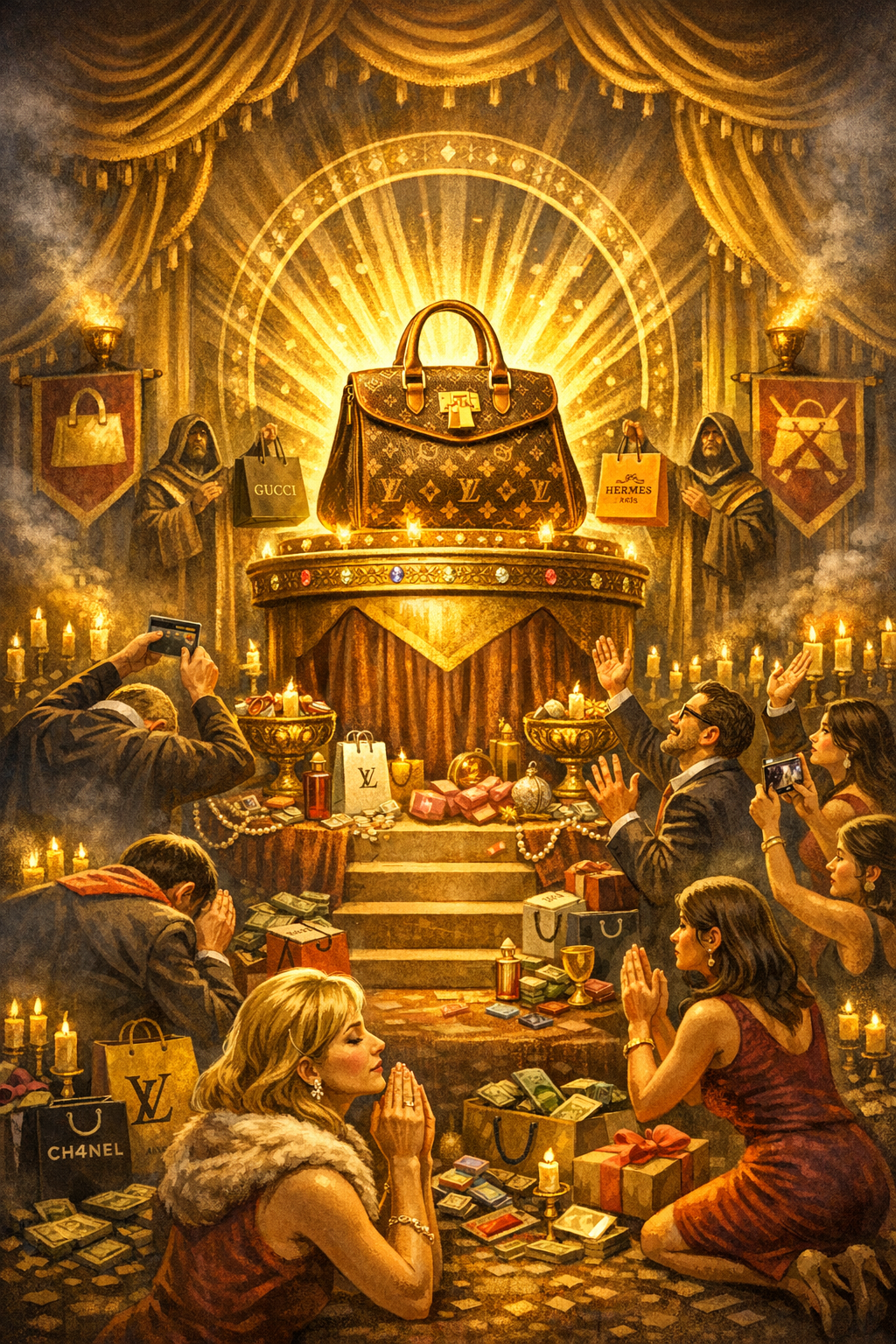
Then came the designers. Louis Vuitton, Hermès, Chanel, and their descendants transformed the handbag into a cultural weapon. They turned craftsmanship into theology. Stitching became scripture. The handbag was no longer a container—it was a confession of faith in luxury itself. To own one was to declare allegiance to the church of consumerism, where salvation came in calfskin and the holy trinity was brand, scarcity, and price.
The absurdity of the handbag lies not in its existence but in its uses. It is carried to display wealth, but often contains nothing of value. It is flaunted at parties, photographed at brunches, and stored in climate‑controlled vaults like endangered species. Some are never used at all, preserved in pristine condition as proof of ownership rather than function. A handbag that never holds anything is the purest expression of modern luxury: value without purpose, possession without use.
The rituals surrounding it are almost religious. The unboxing video has become the digital equivalent of a baptism. Tissue paper is peeled back with trembling reverence, the logo revealed like a divine sigil. The audience gasps. The owner smiles. Somewhere, a marketing executive lights a cigar and whispers, “Amen.” The handbag is not purchased—it is consecrated.
And then there’s the investment angle. In a world where financial markets wobble and currencies fluctuate, the handbag has become a surprisingly stable asset. A Hermès Birkin can appreciate faster than gold, which is both impressive and deeply ridiculous. Imagine explaining to a medieval peasant that in the future, people will trade leather pouches as financial instruments. They would assume civilization had collapsed—and in a way, they’d be right.
The absurdity reaches its peak in the realm of celebrity culture. When a famous person is photographed clutching a rare handbag, the internet erupts in analysis. Entire articles are written about the color, the stitching, the symbolism. The bag becomes a political statement, a moral stance, a prophecy. It’s leather, yes—but also lifestyle, aspiration, and myth. The celebrity doesn’t just carry a bag; they carry the collective longing of millions who believe that owning the same object might somehow transfer the same aura.
Even the way people interact with their handbags borders on performance art. Watch someone with a designer bag enter a café—they don’t carry it; they present it. It’s held at just the right angle, placed on the table like a royal decree, never allowed to touch the floor (because apparently, that would offend the gods of fashion). The bag becomes a character in the scene, a silent co‑star that says, “I am successful, I am tasteful, I am better than you.”
Inside, of course, lies the usual chaos: a phone, a wallet, a half‑eaten granola bar, and a receipt for dry cleaning. The luxury exterior conceals the same mess as any other human life. It’s a portable paradox—a vessel of perfection filled with imperfection. The bag promises transcendence but delivers crumbs.
And yet, the handbag persists, because it fulfills a deep psychological need. It is a portable identity, a way to carry one’s self‑image through the world. It says, “I belong to the tribe of those who can afford this.” It is armor against invisibility, a shield against the terror of being ordinary. In a society obsessed with appearances, the handbag is both weapon and wound.
The true genius of the luxury handbag industry is its ability to make people feel grateful for being exploited. Customers thank brands for allowing them to spend obscene amounts of money. Waiting lists are treated like spiritual pilgrimages. People beg to be permitted to buy. It’s capitalism at its most poetic—the transformation of desire into devotion.
The absurdity doesn’t stop at ownership. There are handbags designed purely for display, handbags made of transparent plastic to show off the contents, handbags shaped like hamburgers, handbags so small they can’t fit anything larger than a single breath mint. There are handbags that cost more than houses, handbags that require armed guards, handbags that have their own Instagram accounts. The handbag has transcended utility and entered mythology. It is no longer a product—it is a personality.
If future archaeologists ever dig through the ruins of our civilization, they will find luxury handbags and assume they were religious relics. They will note the rituals surrounding them, the sacrifices made to acquire them, the reverence with which they were displayed. And they will be right. The handbag is our modern idol—a shrine to vanity, stitched in calfskin and lined with self‑importance.
It holds nothing essential, yet it holds everything we think we are. It is the triumph of marketing over meaning, of leather over logic, of status over sanity. And for that reason, it deserves its place among humanity’s most absurd inventions—an empty vessel overflowing with significance.
Add comment
Comments